

Last Updated: July 7, 2026
While new technological tools have become commonplace today, Colin Foster and his team at Virtual Service have been a pioneering voice in the sector for three decades, bringing innovation to the forefront of service and living.
Colin Foster is the Founder and Chief Innovation Officer of Virtual Service and the creator of VIRTUAL DOORMAN®, the pioneering remote building-wide entry and access management platform for residential buildings. Years before the sector developed into the common commodity that it is today, Foster recognized that technology, live human judgment, and building operations could be integrated to deliver a new model of access, security, and resident service.
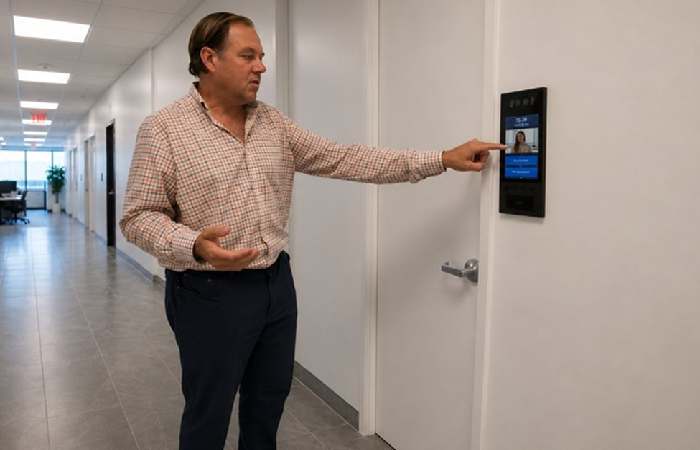
Colin Foster, Chief Innovation Officer of Virtual Service and the creator of VIRTUAL DOORMAN®
Since founding the company, Foster has led the development of a platform that combines installed access infrastructure, video intercom technology, centralized software, and trained live operators to help buildings manage visitors, deliveries, vendors, residents, and real-time access events. What began as a solution to a very practical urban living problem has evolved into a nationally deployed operational system serving multifamily, condominium, and mixed-use properties.
Foster’s Origins
Foster is widely regarded as the creator and trusted authority in the category. His work has helped redefine how residential buildings think about staffing, access control, resident convenience, and operational efficiency. In these ways, he and his team have moved the industry beyond simple intercoms and into a more intelligent, service-driven model of building management.
What Is VIRTUAL DOORMAN®?
The idea for VIRTUAL DOORMAN® came from real-world frustrations that Foster himself was facing years ago. He was living in New York City and saw a clear divide between buildings that had full-time doormen and those that did not. More than just an inconvenience, he saw it as full-blown stratification and sought to come up with a technological solution that could serve as a beneficial bridge between these two distinct classes of New York residents.
At these luxurious residences, the doorman provided convenience, security, and accountability. Yet, the reason these buildings were able to have a doorman at all was because of how high the prices were. The owners of the residences could afford to pay a full-time doorman without losing money. Smaller-scale residences were not able to afford a doorman and maintain their lower pricing. Thus, Foster sought to provide a viable solution in the form of VIRTUAL DOORMAN®.
 An Equalizing Force
As he explains, “The question became: Could we take the most valuable parts of the doorman experience, human judgment, controlled access, visitor assistance, package support, and building oversight, and deliver them remotely through technology?” As such, the technology became far more than just a simple tool; it sought to integrate multiple layers of technology and service into one managed building operations platform.
The system utilizes security cameras, an intercom system, and an app, all in the name of providing residents with a greater degree of safety, security, and accessibility. By combining connected hardware, software, and trained human intervention, the Virtual Service team was able to create a much more intelligent operating system for residential buildings.
The Success of the System
VIRTUAL DOORMAN® clients include multifamily portfolios and residential communities serving tens of thousands of residents across the states of New York, New Jersey, Connecticut, California, Florida, Illinois, Indiana, Maryland, Ohio, Pennsylvania, Texas, and Virginia, to name a few. Virtual Service has a client retention rate consistently in the high ninety-percent range and long-standing partnerships spanning decades.
In 1997, when VIRTUAL DOORMAN® was introduced, there was no scalable solution between basic intercom systems and full-time doorman staffing. By combining technology with live, remote operators, it became the trailblazer of virtual concierge and remote access control systems, establishing a new approach to building access.